

Self-service ordering didn’t start with QR codes, and it won’t end with them. What QR codes did—very effectively, for a time—was remove the need for printed menus and in-person ordering. They solved a distribution problem. Menus could live on phones instead of paper, and customers could access them without touching anything.
That mattered. It still does.
But as customer expectations continue to shift, the question is no longer whether self-service ordering works. It’s how friction shows up in the experience—and whether it quietly gets in the way of completing an order.
That’s where the comparison between NFC tap-to-order and QR code ordering becomes meaningful.
Same Goal, Different Interactions
At a glance, QR code ordering and NFC tap-to-order are trying to accomplish the same thing. Both are designed to move customers from intent to menu as quickly as possible. Both aim to reduce lines, lighten staff workload, and give customers more control over their ordering experience.
The difference isn’t philosophical. It’s behavioral.
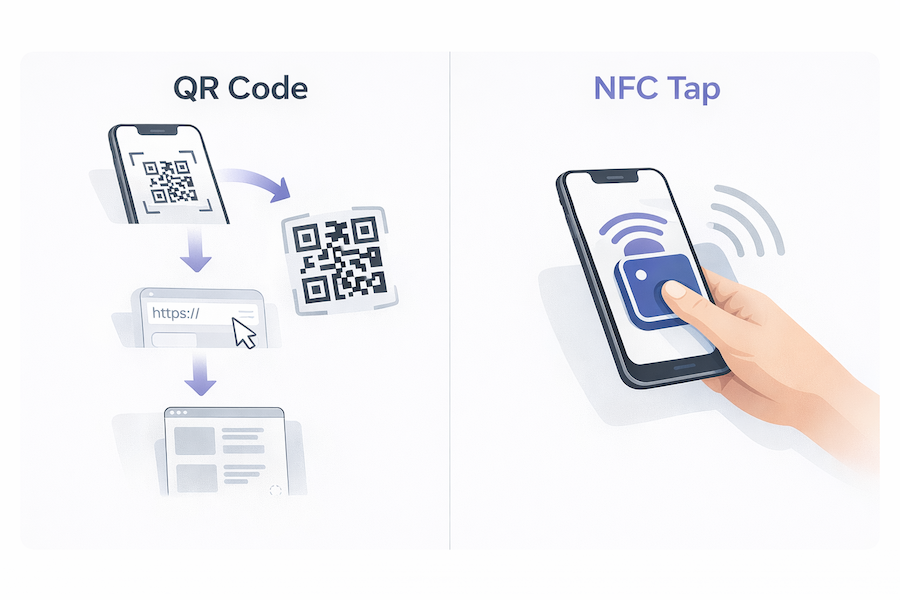
QR codes ask customers to scan. NFC asks them to tap.
That distinction may sound small, but in real environments—busy counters, dim lighting, crowded tables, older clientele—it changes how often customers actually engage with the system in front of them.
What QR Code Ordering Gets Right
QR codes became widespread for good reasons. They were easy to deploy, inexpensive to print, and required no new hardware. Most people had at least some familiarity with scanning by the time QR menus became common, and during the height of contactless adoption, they felt like the obvious solution.
In many settings, QR codes still work just fine. Tech-savvy customers know what to do. Phones can scan quickly under ideal conditions. For venues with younger audiences or lower volume, QR ordering remains a practical option.
None of that should be dismissed.
Where QR Codes Start to Add Friction
The challenge with QR code ordering isn’t that it’s broken. It’s that it quietly asks more of the customer than it appears to.
Scanning requires intention. The customer has to open their camera, align the code, wait for the prompt, and trust that the link they’re opening is legitimate. In bright light, that’s easy. In dim rooms, crowded bars, or outdoor settings, it’s less so.
There’s also a familiarity gap. Many customers—especially older ones—still assume scanning means downloading an app or navigating additional steps. Even when that isn’t true, the uncertainty alone is enough to stop them from trying.
Over time, QR codes have also picked up a subtle trust issue. As people have become more aware of malicious links and spoofed codes, hesitation has increased. A printed square on a table doesn’t always inspire confidence, even if the venue itself is trusted.
None of these issues are dramatic on their own. But when ordering depends on momentum, small pauses matter.
How NFC Tap-to-Order Changes the Experience
NFC tap-to-order removes the interpretive step entirely.
There’s no camera to open, no square to align, no decision to make about whether a link is safe. The customer taps their phone, and the menu opens. The interaction mirrors something they already do daily—tapping to pay, unlock, or verify.
Because the action is physical and immediate, it feels more natural. Customers don’t wonder what to do. They don’t second-guess whether it will work. The system meets them where their habits already are.
In practice, this lowers the barrier to engagement. More people open the menu. More people browse. Fewer people abandon the process before it begins.
Speed Isn’t Just About Seconds
It’s tempting to frame this comparison purely in terms of speed. Tapping is faster than scanning, and in isolation, that’s true. But the real difference shows up in flow, not seconds.
Tap-to-order shortens the mental distance between noticing the option to order and actually ordering. There’s less friction, less uncertainty, and less hesitation. In high-traffic environments, that smoothness compounds across dozens—or hundreds—of interactions.
The result isn’t just faster access to a menu. It’s a calmer space, fewer choke points, and a more consistent ordering rhythm throughout the day.
Familiarity Matters More Than Features
Most customers don’t evaluate ordering systems based on features. They respond to what feels familiar and easy.
Tapping already carries an association with completion. You tap when you’re ready to move forward. Scanning still feels like the beginning of a process, not the end of one.
That distinction affects who participates. Younger customers may be comfortable scanning without thinking twice. Older customers are far more likely to hesitate—or skip self-ordering entirely—when scanning is required. Tap-to-order narrows that gap by relying on a behavior that already spans age groups.
Reliability in Real-World Conditions
Physical environments are rarely ideal. Lighting changes. Signs get scratched. Stickers peel. Printed QR codes fade or warp.
NFC tags are more forgiving. They don’t rely on visual clarity. They don’t degrade in the same way. And because the interaction happens at close range, it’s more consistent across different settings.
That reliability matters most in venues where speed and volume fluctuate throughout the day. When ordering infrastructure works the same way every time, staff can focus on fulfillment instead of troubleshooting.
Security and Trust Perception
From a technical standpoint, both QR code ordering and NFC tap-to-order can be secure when implemented correctly. The difference lies in perception.
NFC interactions are short-range by design. Customers intuitively understand that tapping requires proximity. That physical constraint creates a sense of safety, even if the customer never consciously thinks about it.
QR codes, by contrast, can be scanned from a distance and are visually indistinguishable from one another. As awareness of QR-based scams has grown, so has hesitation—even in legitimate settings.
Trust doesn’t need to be explained. It needs to be felt. Tap-to-order benefits from that instinctive confidence.
Choosing the Right Approach
This isn’t about declaring a winner in every scenario. QR code ordering still has a place. In some environments, it’s sufficient. In others, it’s already familiar enough that switching wouldn’t meaningfully improve the experience.
But when the goal is to reduce friction as much as possible—especially in high-traffic or mixed-demographic spaces—tap-to-order offers a quieter, smoother interaction. It doesn’t ask customers to learn anything new. It simply removes a step they no longer need.
Many venues ultimately land on hybrid models, using both approaches where they make sense. The key is understanding where friction shows up and choosing the interaction that minimizes it.
A Subtle Shift With Real Impact
QR codes helped businesses move forward quickly when circumstances demanded it. NFC tap-to-order reflects what happens next, as expectations normalize and convenience becomes the baseline rather than a bonus.
The difference between tapping and scanning may seem small on paper. In practice, it changes who orders, how often they engage, and how smoothly a space operates during its busiest moments.
Sometimes progress isn’t about adding features. It’s about removing just enough friction for everything else to work better.
Want to Explore Tap-to-Order Further?
If you’re evaluating self-service ordering options and wondering whether tap-to-order could improve flow in your space, OtterOrder makes it easy to see how it fits—without forcing a full overhaul.
Learn how NFC tap-to-order works alongside modern ordering experiences at OtterOrder.com.