

Self-service ordering has been around longer than most people realize. What’s changed isn’t the idea—it’s the expectations.
Customers no longer tolerate friction where it doesn’t belong. They don’t want to wait in line just to place a simple order. They don’t want to flag down staff who are already stretched thin. And they definitely don’t want to wrestle with clunky technology just to get to a menu.
That shift in behavior is exactly why NFC tap-to-order is gaining traction. Not as a gimmick. Not as a trend. But as a more natural way for people to order in the physical world.
The Short Answer
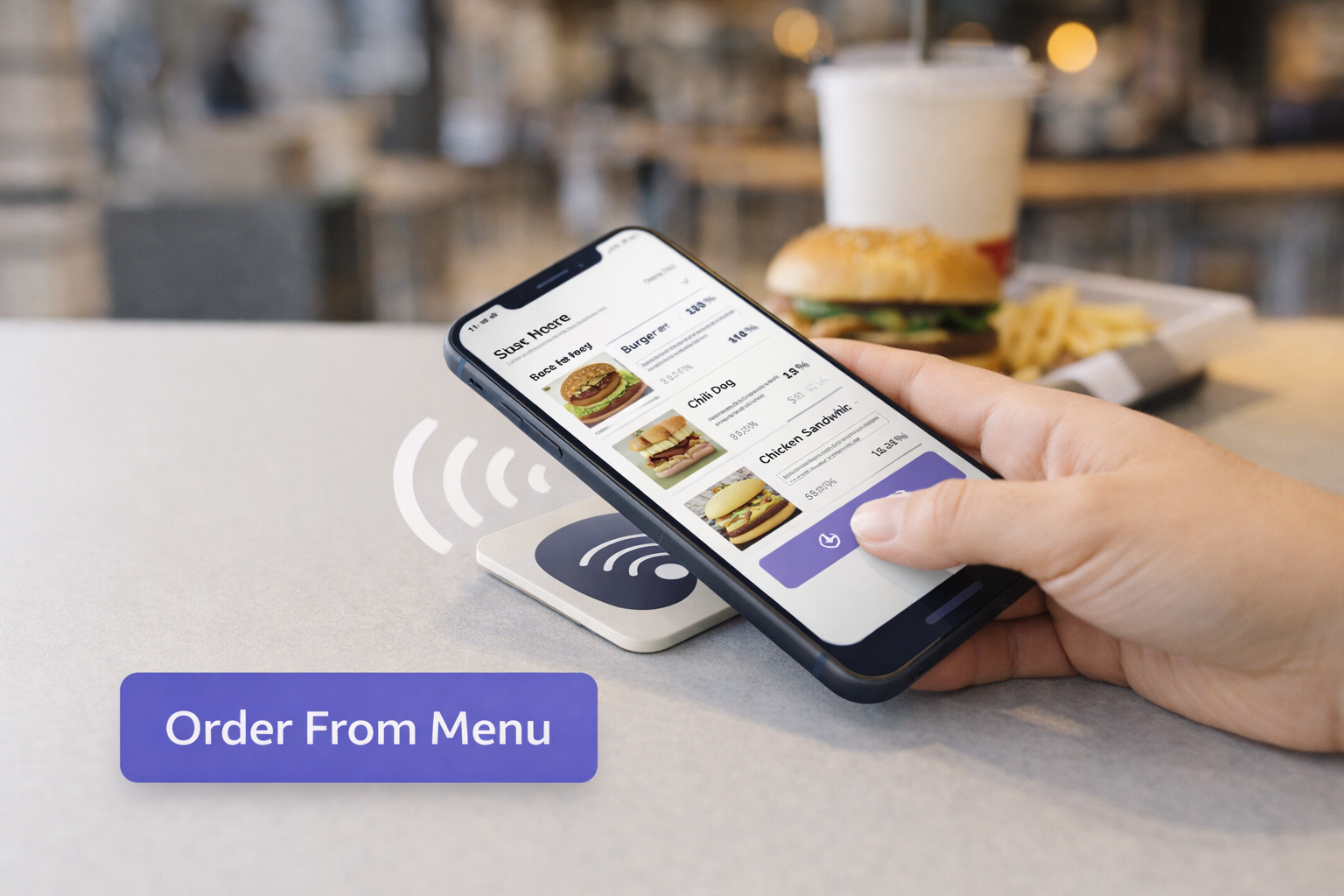
NFC tap-to-order allows customers to open a mobile ordering menu by simply tapping their phone on a physical NFC tag. No camera. No scanning. No app download.
The interaction feels familiar because it mirrors behaviors people already trust—like tapping to pay with Apple Pay or Google Pay. The menu opens instantly, customers browse at their own pace, and orders are placed without waiting or confusion.
It’s faster than QR codes, more intuitive for a wider range of customers, and better aligned with how people already use their phones.
Why This Matters Right Now
QR codes had their moment, and for good reason. They were quick to deploy and easy to understand during a time when contactless interactions became necessary overnight.
But the world has moved on.
Today’s customers are less patient, more skeptical, and far more accustomed to tap-based interactions than scan-based ones. Opening a camera, lining up a QR code, waiting for a link to appear—it all feels slightly outdated when compared to the simplicity of a single tap.
At the same time, businesses are facing their own pressures. Staffing remains tight. Labor costs continue to rise. Lines still kill conversion. Every extra step between intent and purchase creates an opportunity for someone to walk away.
NFC tap-to-order sits directly at the intersection of those realities. It removes friction for customers while reducing operational strain for businesses.
What “NFC” Actually Means
NFC stands for Near Field Communication. It’s the same underlying technology used in everyday interactions most people already trust.
Tap-to-pay terminals. Contactless credit cards. Transit passes. Hotel room keys. All rely on NFC.
When a phone comes within a few centimeters of an NFC tag, it can automatically open a secure web link. There’s no need for a camera, no permission prompts, and no app installation.
In a tap-to-order setup, that link doesn’t lead to a payment screen alone. It opens a full ordering experience—menus, options, customization, and checkout—designed to work instantly on the customer’s phone.
How Tap-to-Order Actually Works
From the customer’s perspective, the experience is almost invisible.
They tap their phone on a small NFC marker placed on a counter, table, lane, or wall. The menu opens immediately. No instructions are required, because the action itself is self-explanatory.
From there, customers browse the menu, customize their order, and complete payment directly on their device. The order is routed into the venue’s fulfillment flow—whether that’s staff at a counter, a prep area, or another system entirely.
There’s no line to manage and no bottleneck at the point of order. The process feels calm, modern, and effortless, even in high-traffic environments.
Tap-to-Order vs. QR Code Ordering
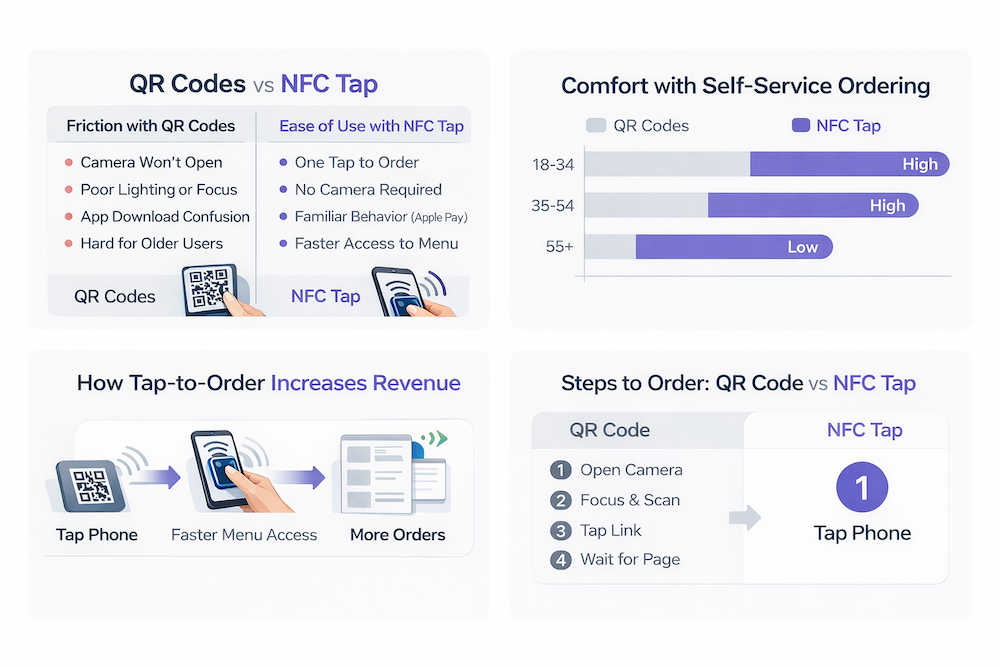
QR codes aren’t inherently bad. They’re just older technology with more built-in friction.
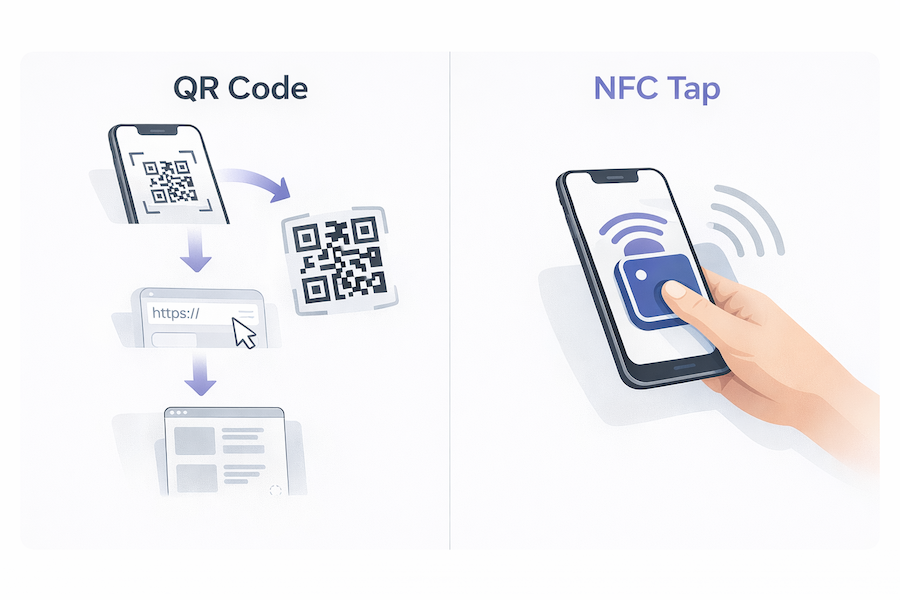
Scanning requires intent. It requires the right lighting. It requires trust in a printed square. And for many customers—especially those who aren’t deeply comfortable with smartphones—it introduces uncertainty.
Tap-to-order removes those barriers. One physical action replaces several digital steps. There’s nothing to line up, nothing to focus, and nothing to interpret.
In busy environments, the difference between tapping and scanning may only be a few seconds. But those seconds add up. Over the course of a day, they can mean more completed orders, fewer abandoned purchases, and a noticeably smoother flow through a space.
Why Tapping Feels Better Than Scanning
Human behavior matters more than feature lists.
People already associate tapping their phone with trust and completion. You tap to pay. You tap to unlock. You tap to board. You tap to verify.
Scanning, by contrast, still feels like work. It requires alignment, attention, and a small leap of faith—especially when QR codes are placed on stickers, table tents, or printed signs.
When given the choice, most people instinctively gravitate toward the option that feels familiar and effortless. “Tap your phone here” simply feels easier than “open your camera and scan this.”
That preference has real consequences. It affects how many people actually open the menu, how long they stay engaged, and how likely they are to complete an order.
Compatibility Isn’t a Problem
Tap-to-order works on modern smartphones without special setup.
Recent iPhones support NFC tag interactions natively. Android devices have supported NFC for years. Customers don’t need to download an app, enable hidden settings, or create an account.
They just tap. The experience works because it aligns with default device behavior, not because users are asked to change how they use their phone.
A Word on Security
Security concerns are reasonable, especially when payments are involved.
NFC tap-to-order systems don’t store personal information on the tag itself. The tag simply triggers a short-range interaction that opens a secure web page. From there, payments are processed through encrypted checkout flows, just like any modern e-commerce experience.
In practice, tapping is often safer than scanning unknown QR codes, which can be easily altered or replaced. The short-range nature of NFC interactions adds an additional layer of trust that customers intuitively understand—even if they don’t consciously think about it.
Where Tap-to-Order Shines
Tap-to-order isn’t a universal solution, but it excels in environments where speed, clarity, and flow matter most.
High-traffic venues benefit immediately. Lines disappear, staff pressure eases, and customers move through the space more naturally.
Repetitive ordering environments also see strong results. When customers already know what they want, removing friction helps them get there faster without unnecessary interaction.
Staff-limited operations gain breathing room. Self-service absorbs demand spikes without forcing employees to rush or multitask beyond reason.
That’s why tap-to-order works particularly well in places like gun ranges, breweries, food halls, cafés, arcades, gyms, event venues, and hotels—anywhere customers want to order quickly and get back to what they’re doing.
The Revenue Impact Is Real
Convenience is nice. Revenue is better.
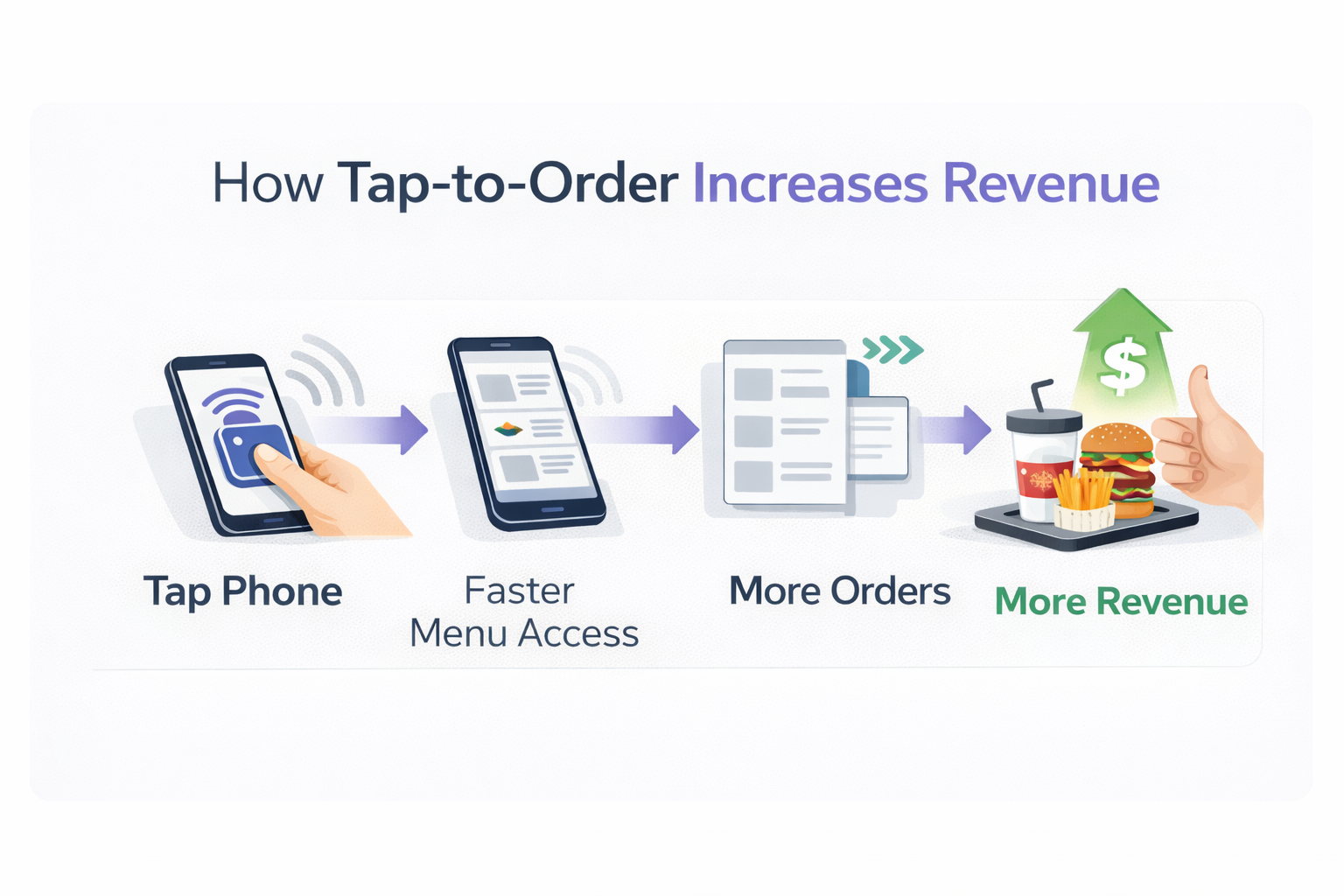
Faster access to a menu leads to more completed orders. Digital menus encourage browsing, which naturally increases average order value. Upsells feel less awkward when they’re presented visually rather than verbally.
Perhaps most importantly, removing lines reduces abandonment. When ordering doesn’t require waiting, fewer customers walk away.
The result is a smoother experience that benefits both sides of the transaction—customers feel in control, and businesses capture more of the demand already in the room.
Why Not Just Use Kiosks?
Self-service kiosks solve some of the same problems, but they introduce new ones.
They take up physical space. They require maintenance. They create their own lines when demand spikes. And scaling them across a venue can be expensive.
Tap-to-order uses something customers already carry—their phone. It scales instantly, has no single point of failure, and adapts easily to different layouts and use cases.
For many businesses, it’s simply the lighter, more flexible approach.
When Tap-to-Order Isn’t the Right Fit
It’s worth being honest. Tap-to-order isn’t ideal for every situation.
Highly consultative environments still benefit from personal interaction. Extremely complex orders may require guidance. Some spaces intentionally discourage phone use altogether.
In those cases, tap-to-order doesn’t need to replace staff—it can complement them. Many venues succeed with hybrid models that blend self-service and human interaction without forcing a hard choice between the two.
This Isn’t a Gimmick
QR codes were a bridge. Tap-to-order is the next step.
As customers grow more accustomed to tapping instead of scanning, businesses that adopt NFC early gain a subtle but meaningful advantage. Service feels faster. Spaces feel calmer. Brands feel more modern without trying too hard.
At its core, tap-to-order represents the simplest possible interaction between a customer and a purchase.
And simplicity, when done well, wins.
Final Thoughts
NFC tap-to-order allows customers to order by doing something they already understand—tapping their phone.
For businesses dealing with lines, labor constraints, missed sales, or slow ordering flows, it isn’t just a convenience feature. It’s a strategic shift toward a smoother, more intuitive experience.
As self-service ordering continues to evolve, tap-to-order stands out not because it adds complexity, but because it removes it.
Want to See It in Action?
If you’re curious how tap-to-order could work in your space—without ripping out your existing systems or changing how your business operates—OtterOrder makes it easy to get started.
Explore how NFC tap-to-order fits into a modern ordering experience, or see how other venues are using it to streamline service and increase revenue.
Learn more at OtterOrder.com.