

Point-of-sale systems were built for a very specific world. A counter. A register. A single place where orders are taken and payments are processed. For decades, that model worked well enough.
But venues changed.
Not just new venues—older ones too. Stadiums, theaters, bowling alleys, golf courses, and entertainment complexes have always operated in ways that don’t fit neatly into the assumptions most POS systems are built on. As venues became larger, more distributed, and more experience-driven, the limitations of traditional POS software became harder to ignore.
The problem isn’t that POS systems are outdated. It’s that they were never designed for how modern venues actually function.
The Single-Counter Assumption
At their core, most POS systems assume a single point of interaction. Even when they support multiple terminals, the underlying model remains the same. Orders originate at a counter. Payments flow through a register. Everything else is layered on top of that foundation.
This works fine in a traditional restaurant where customers come to one place to order and staff manage the rest. But many venues don’t operate that way, and never have.
Movie theaters are a perfect example.
Why Movie Theaters Expose the Problem
On the surface, movie theaters feel like a solved industry. They’ve existed for over a century. They sell food. They assign seats. They manage high volumes of guests.
And yet, ordering inside a theater remains surprisingly primitive.
Each individual theater room functions like its own restaurant. Guests are seated. They stay in place for long periods of time. Orders could theoretically be taken and delivered directly to seats. But traditional POS systems can’t handle that model cleanly.
Instead, theaters are forced into workarounds. Concessions operate as a separate business. Ordering happens before the movie. Seat-level service becomes operationally complex or impossible to scale. Each theater room has to be treated as an independent operation, even though it’s part of a larger whole.
The issue isn’t a lack of imagination. It’s a lack of infrastructure. There hasn’t been a system designed to treat distributed spaces—like individual theaters—as independent ordering environments within one unified venue.
Until now.
Restaurants Had One Dining Room. Venues Have Many.
A restaurant typically has one dining room, one ordering flow, and one kitchen. Even when the space is large, the logic remains centralized.
Modern venues don’t work like that.
A movie complex has thirty theaters. A food court has dozens of vendors. A bowling alley has multiple lanes operating simultaneously. A golf course spans hundreds of acres. A pickleball or tennis facility has courts scattered across a property.
Each of these spaces functions independently from the customer’s perspective. They are distinct locations where orders should be placed, fulfilled, and delivered based on where the customer is, not where a counter happens to be.
Traditional POS systems were never designed for that level of spatial awareness.
The Real Problem: Location-Based Ordering
What modern venues require isn’t just ordering—it’s location-based ordering.
The ability to place an order from a specific seat, lane, court, table, or area. The ability to route that order correctly without staff guessing where it belongs. The ability to manage payments, fulfillment, and delivery across many micro-locations inside one venue.
POS systems don’t struggle because they’re old. They struggle because they treat location as an afterthought rather than a core concept.
Why Workarounds Don’t Scale
Over time, venues have tried to patch these gaps with add-ons. Tablets get added. Kiosks appear. QR codes point to external systems. Staff become runners and interpreters, translating orders into actions.
These solutions work temporarily, but they introduce friction instead of removing it. More devices. More systems. More opportunities for error.
The venue grows more complex, not more efficient.
A System Built for Distributed Spaces
OtterOrder approaches this problem from a different starting point.
Instead of assuming a single counter, the system assumes many points of interaction. Ordering and payments are not tied to a POS terminal. They’re tied to where the customer is.
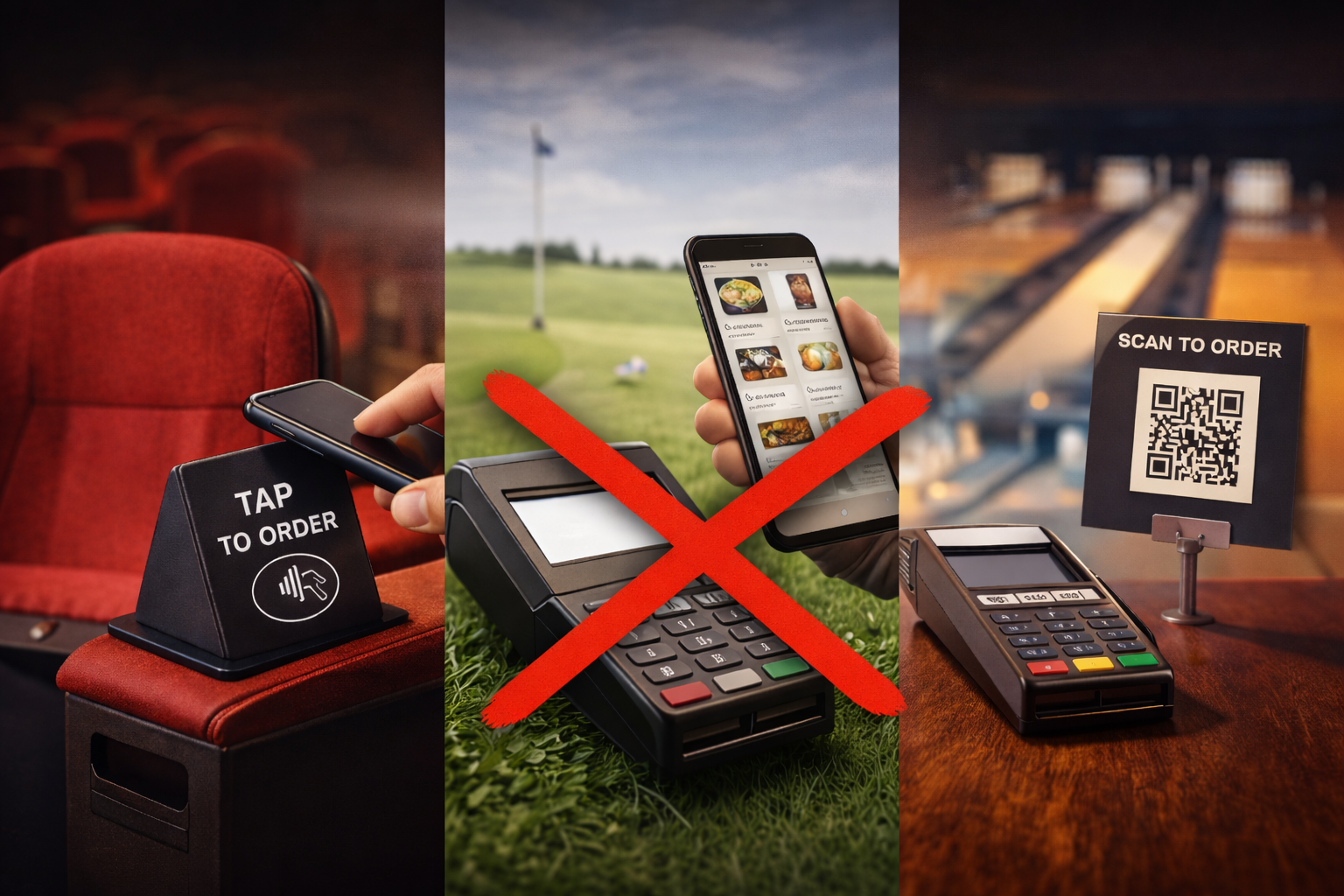
That means a seat in a movie theater. A lane at a bowling alley. A court at a pickleball or tennis facility. A location on a golf course. A table in a food court. A pickup area at a food truck. A kiosk in a high-traffic venue.
Orders can be placed through NFC taps, QR codes, or tablets. Payments happen in the same system. Fulfillment is routed based on location, not guesswork.
There’s no need to split a venue into artificial “businesses” just to make software behave.
Beyond Hospitality
While food and beverage make the problem obvious, this challenge extends far beyond hospitality.
Entertainment venues, recreational facilities, and experience-based spaces all share the same need: letting people order where they are, without forcing them to leave the experience to find a counter.
POS systems were built to manage transactions. Modern venues need systems that manage interaction.
Simplicity Unlocks Possibility
The breakthrough isn’t a new feature. It’s a new assumption.
When ordering and payments are decoupled from a fixed point of sale, venues gain flexibility they never had before. Service becomes contextual. Operations become calmer. Experiences become more seamless.
What once required custom development or expensive workarounds becomes straightforward.
Final Thoughts
POS systems weren’t built for modern venues—not because the venues are new, but because the way people interact with spaces has evolved.
As experiences become more distributed and location-aware, the tools powering them need to evolve too. Ordering shouldn’t be constrained by counters, registers, or outdated assumptions about how service works.
The future of venue operations isn’t about replacing staff or adding complexity. It’s about meeting customers where they already are.
Curious What That Looks Like in Practice?
If you operate a venue where ordering should happen from seats, lanes, courts, or anywhere else customers spend their time, OtterOrder shows how location-based ordering and payments can live in one simple system.
Learn more at OtterOrder.com.