

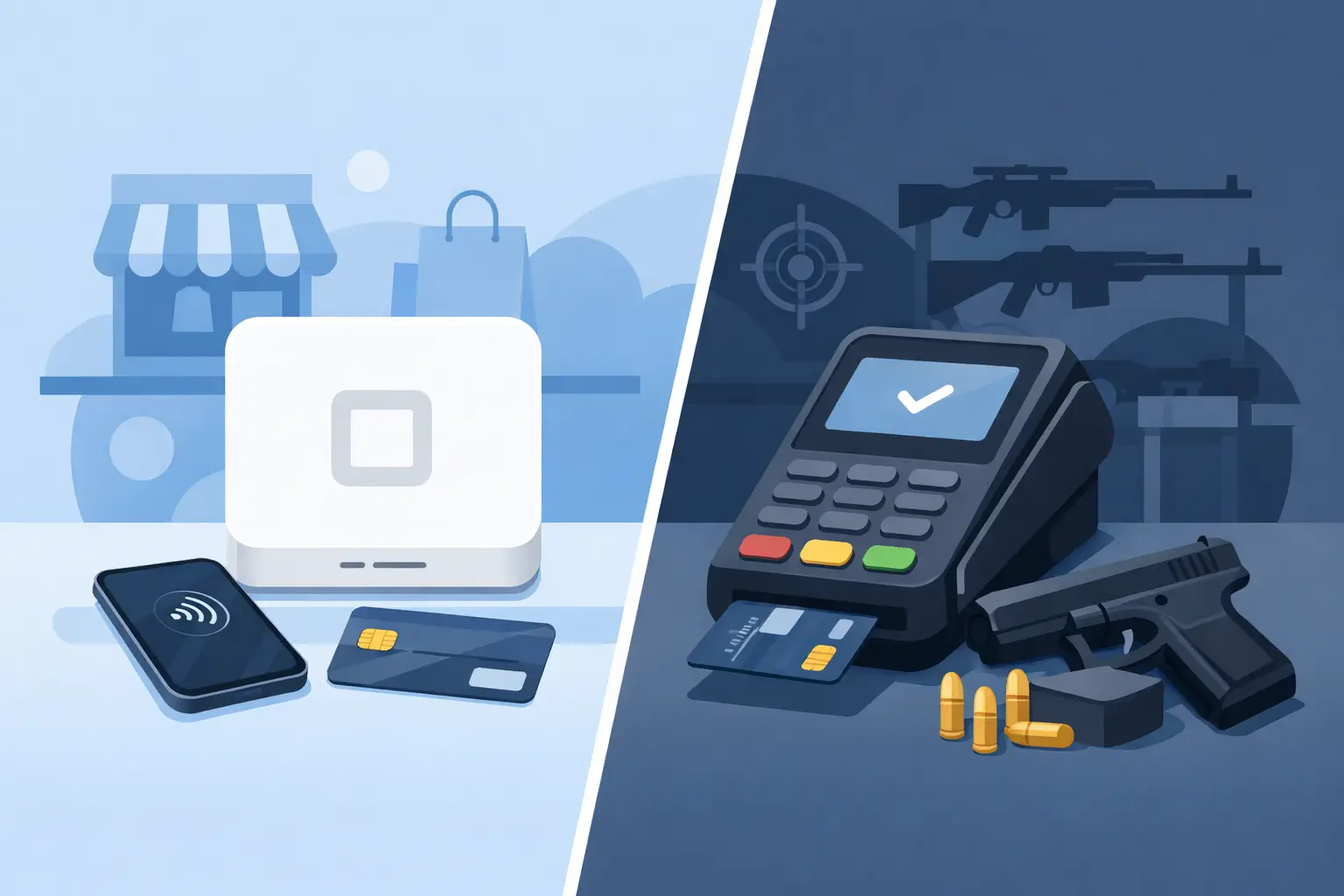
If you sell firearms, accessories, or range services, choosing between Square vs firearm friendly payments is not a branding decision. It is a risk decision. The wrong payment setup can interrupt sales, hold funds, or force you to rebuild checkout in the middle of a busy weekend.
That matters more in firearms than in most businesses because your operation is already dealing with compliance, inventory controls, transfers, and customer verification. You do not need your payment provider adding uncertainty on top of that. What works for a coffee shop is not always built for an FFL, a gun show table, or a range counter.
Square vs firearm friendly payments: the real difference
On the surface, Square looks appealing. It is easy to set up, familiar to customers, and simple for small operators to understand. If you have used it in another business, the learning curve is low. That is exactly why many new operators consider it first.
The problem is that ease of setup is not the same as fit. Firearm friendly payments are built around the reality that regulated merchants need a processor and platform that understands the category, accepts the category, and is willing to support it over time. That is a very different standard than simply being easy to download and start using.
With Square, the question is not just whether you can technically key in a payment or plug in a reader. The bigger question is whether your business model aligns with what the provider is willing to underwrite and support. In firearms, that detail can decide whether your account stays active.
A firearm friendly payment provider starts from the opposite position. Instead of asking whether your business fits a general retail template, it is built to work with FFLs and related merchants from day one. That changes everything from account stability to underwriting to how confidently you can scale.
Why Square can be a bad fit for firearms sellers
Square became popular by removing friction for mainstream retail. That model works well when the products are simple, the rules are consistent, and the risk profile is broad and predictable. Firearms are none of those things.
An FFL has category-specific compliance requirements, more operational scrutiny, and a higher chance of running into restrictions from payment providers that prefer lower-risk merchants. Even if a provider supports some adjacent outdoor or sporting categories, that does not automatically mean it is a fit for firearm transactions.
This is where operators get burned. They assume that because a checkout solution is common, it is safe for their business. Then they run into holds, reviews, limitations, or account issues right when volume picks up. For a dealer at a gun show or a shop during hunting season, that is not a minor inconvenience. It is lost revenue and a credibility hit with customers standing at the counter.
There is also a practical issue. Firearms businesses are often mobile, event-driven, or operating in environments where connectivity is unreliable. If your setup depends on perfect internet, fixed hardware, or a system designed around a standard storefront, you are already making life harder than it needs to be.
What firearm friendly payments actually solve
When operators hear the phrase firearm friendly payments, they usually think first about approval. That is part of it, but not the whole story.
A good firearm friendly setup is about staying live, getting paid, and keeping checkout simple in the real world. That means your payments are backed by a provider that will not treat your account like a mistake waiting to be corrected. It also means your ordering and checkout tools fit the way you actually sell.
For some businesses, that means taking payments at a fixed counter. For others, it means selling at a gun show, processing transactions at an outdoor range, or handling low-connectivity environments without dragging around proprietary hardware. It may also mean managing inventory across firearms, accessories, apparel, and range fees from one place instead of stitching together multiple systems.
The right platform should reduce operational drag, not add another layer of babysitting.
Account stability matters more than low-friction signup
This is the part many new operators underestimate. A quick signup feels good on day one. Stable processing matters on day 100.
Mainstream payment tools often win the comparison at the first impression stage. The interface is polished. The setup is fast. The hardware is familiar. But if your category sits outside their comfort zone, that convenience can disappear fast.
Firearm friendly payments are usually a better fit for operators who care more about long-term reliability than instant approval theater. Yes, underwriting may require more upfront clarity. That is not a flaw. In regulated industries, clear underwriting is usually what protects you from future surprises.
If you are an FFL, you should want a provider that knows what you sell, knows how your business operates, and approves you on that basis. That beats hoping a general platform will keep working once your transaction history tells the full story.
Square vs firearm friendly payments for mobile operators
This comparison gets even sharper when the business is mobile. Gun shows, pop-up sales environments, and outdoor events do not give you much room for technical drama. You need checkout to work fast, on familiar devices, without a lot of training or extra hardware.
Square has long appealed to mobile sellers because it made card acceptance feel simple. But simplicity alone is not enough if the merchant category itself is the issue. For firearm-related businesses, mobile payment convenience only helps if the account behind it is built to support the business in the first place.
That is where a firearm friendly platform earns its keep. If you can run checkout from an iPhone, Android, or iPad, take online or offline payments, and avoid hardware lock-in, you keep your operation flexible. If that same platform is also built for regulated merchants, you are not trading mobility for account risk.
That difference matters at a folding table at a gun show just as much as it does behind a retail counter.
The best choice depends on what you actually sell
There is an it depends answer here, and it is worth saying plainly. If your business is general retail with no regulated product exposure, Square may be perfectly fine. Plenty of merchants use it successfully.
But if firearms are part of your business, or if your operation sits close enough to the category that you could trigger underwriting concerns, then the safer move is usually a firearm friendly payment provider. The closer you are to regulated sales, the less sense it makes to force-fit a general tool that was not designed for you.
This is especially true for new FFLs. Early-stage businesses tend to need speed, but they also need a foundation that will not break once they get momentum. Starting with the wrong processor because it looks easy can create more work later when you have to migrate systems, retrain staff, and explain payment issues to customers.
Choosing a platform built for your category is often the faster move when you look past the first week.
What operators should look for instead
A better evaluation framework is simple. Do not just ask whether a platform can take cards. Ask whether it is built to support your business without friction.
You want payments that are accepted for firearms-related use cases, mobile checkout that works on the devices you already own, and the ability to sell online or offline when the signal is weak. You also want inventory tools that can keep up with real SKU complexity and a checkout flow that does not slow down your staff or your customers.
For FFLs, it helps when the sales platform fits the rest of the operation too. If payment support comes together with practical tools for day-to-day selling and compliance-adjacent workflows, you spend less time juggling disconnected systems. That is one reason operators look at platforms like OtterOrder, which are built for regulated and mobile businesses that mainstream tools tend to misunderstand.
The bottom line is straightforward. Square works best for businesses Square was built to serve. Firearm friendly payments work best for businesses that cannot afford to be treated like an exception.
If your livelihood depends on staying live at the counter, at the range, or on the road, choose the setup that understands your business before the first transaction ever runs. That is usually the difference between a checkout tool you hope will hold up and one you can actually run on.