

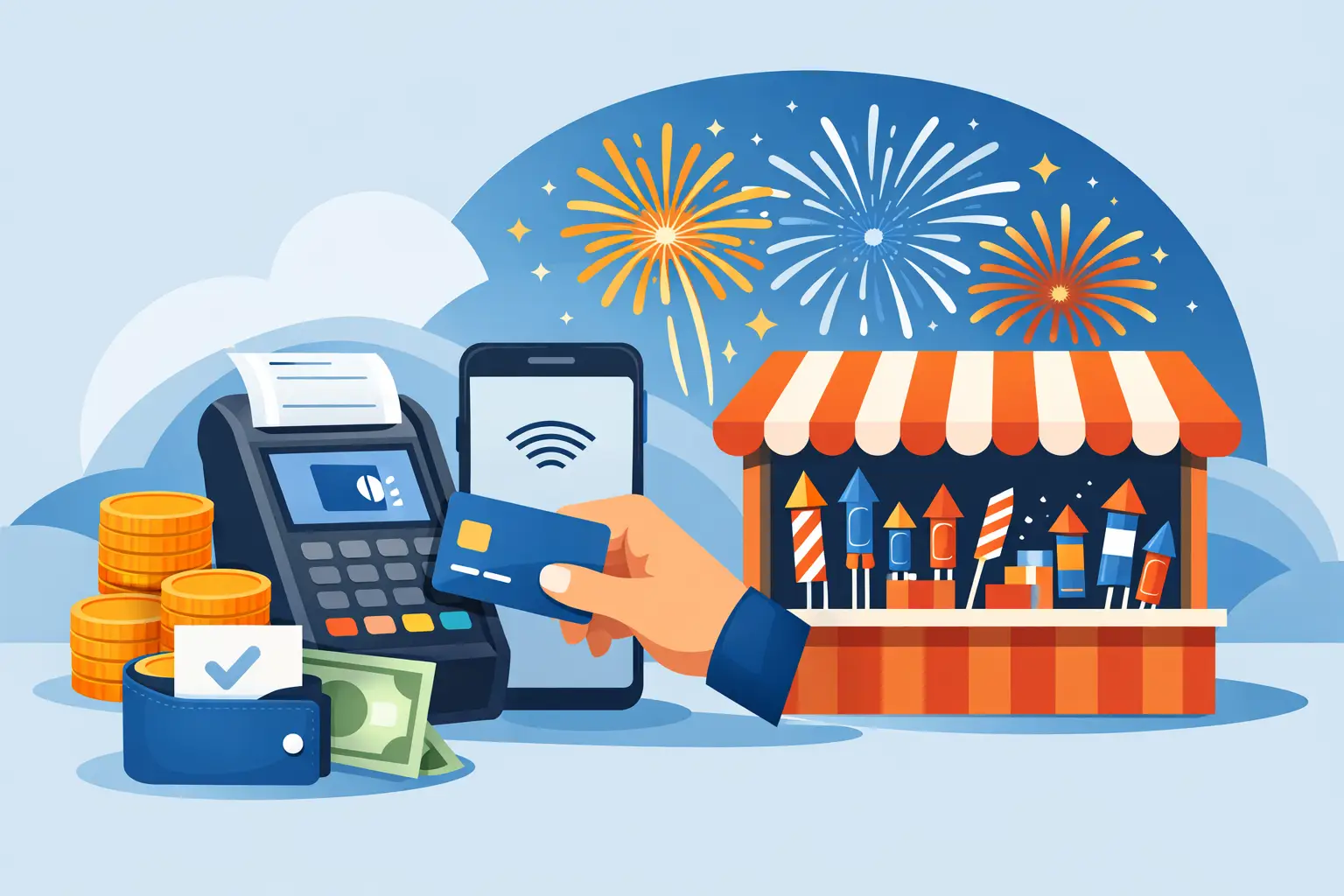
A fireworks stand can go from dead quiet to ten-deep in line fast. When that rush hits, your payment setup either keeps the line moving or costs you sales. That is why choosing the top payment systems for fireworks stands is less about flashy features and more about one question: will it still work when you are slammed, short-staffed, and parked in a lot with weak signal?
For most operators, the answer is not just about taking cards. You need a payment platform that can handle seasonal volume, mobile selling, inventory across dozens or hundreds of SKUs, and the reality that fireworks sales do not happen in a polished retail environment. You may be in a tent, a trailer, a parking lot, or a temporary building with spotty WiFi and one person trying to do everything.
What actually matters in a fireworks stand payment system
If you have run a stand before, you already know the pain points. Card readers stop connecting. Inventory counts drift by day two. Staff hit the wrong item because the menu is messy. Someone asks if you take Apple Pay. The internet drops right as the evening crowd shows up.
That is why the best payment systems for fireworks stands usually get judged on five things: reliability, offline capability, setup speed, inventory control, and account stability. Price matters too, but a cheap tool that fails on July 3 is expensive in all the ways that count.
Reliability is first because the environment is not forgiving. You are often working outdoors, moving fast, and training temporary staff. A good checkout solution should run on hardware you already have or can replace easily, not some proprietary device that becomes a problem the second it breaks.
Offline payments matter more than many operators expect. If your stand loses signal for even 20 minutes during peak hours, that is real revenue walking away. A platform that can keep taking payments offline and sync later is not a nice extra. It is protection.
Inventory is the other big separator. Fireworks stands are SKU-heavy. Even a modest assortment can include fountains, cakes, roman candles, sparklers, assortments, novelty items, and accessories. If your system is too basic, you will end up guessing what sold and what is left. That creates ordering mistakes, shrink, and slower closeouts.
The top payment systems for fireworks stands
There is no single best fit for every operator. A one-location seasonal tent needs something different from a group running multiple stands across a region. Still, a few categories stand out.
Mainstream small-business platforms
Mainstream payment tools are usually the first option operators look at because they are familiar and easy to start with. If you have used one before, the interface will probably feel simple enough to train on quickly. That part is real. For a very small stand with stable internet, a short product list, and low complexity, a mainstream option can get the job done.
The trade-off is that many of these tools were built for coffee shops, boutiques, and fixed retail. Fireworks stands are seasonal, mobile, and often operating in conditions those systems were not built around. Offline support can be limited. Hardware expectations may be too rigid. Inventory can feel shallow once your catalog gets large. And depending on the provider, risk controls built for general retail can create friction for categories they do not fully understand.
That does not mean mainstream always fails. It means you should not confuse familiarity with fit.
Mobile-first payment platforms for field selling
The next group is mobile-first payment platforms designed for operators who sell away from a traditional counter. These systems make more sense for fireworks stands because they are built around phones, tablets, portable readers, and quick setup.
This is where things start to improve for seasonal sellers. You can usually launch faster, move staff around the lot more easily, and avoid being tied to a heavy hardware setup. If your stand is temporary or you run multiple locations, that flexibility matters.
The gap between providers in this category comes down to depth. Some are basically card acceptance tools with light checkout. Others give you inventory, online ordering, QR ordering, loyalty, gift cards, and a dashboard that helps you run the whole operation instead of just charging cards.
Industry-aware platforms built for mobile and regulated sellers
For fireworks operators who want something closer to purpose-built, industry-aware platforms are usually the strongest fit. These systems are designed for businesses that do not operate like standard retail and cannot afford to be misunderstood by their payment provider.
That shows up in practical ways. They tend to support online and offline selling, work on common devices like iPhones, Android phones, and iPads, and avoid forcing you into proprietary hardware. They also understand that one operator may need counter checkout, QR code ordering, and self-service options in the same setup.
A strong example is OtterOrder, which is built for operators in specialty, mobile, and regulated businesses that mainstream providers often underserve. For a fireworks stand, that means you can take payments on the devices you already have, keep selling even when connectivity is shaky, track inventory across every SKU, and manage multiple sales channels from one dashboard. That kind of setup is useful when your business is compressed into a short season and every selling hour counts.
How to compare payment systems without wasting time
Most comparison articles make this too abstract. For a fireworks stand, the real test is operational.
Can you get live fast?
If a platform takes days of setup, custom hardware, or a long training curve, it is already working against you. Seasonal operators need speed. You should be able to load products, connect a reader, and start selling without turning setup into a side job.
Can it handle bad internet?
This needs a direct answer before you sign up. Not vague wording, not marketing copy. Ask how offline payments work, what happens if the connection drops mid-transaction, and how data syncs later. If the answer is fuzzy, keep moving.
Does inventory work the way fireworks inventory works?
A fireworks stand is not selling ten identical shirts in three sizes. You are often managing lots of distinct items, changing stock levels quickly, and bundling products in ways that can confuse a basic catalog. The system should make search easy, let staff find items quickly, and give you clean end-of-day visibility.
Will it support the way you sell?
Some stands only need one checkout point. Others need a counter, a handheld option for line busting, and a QR code on signage so customers can order while they wait. If your platform only fits one selling mode, it may slow you down once volume picks up.
What are the real costs?
Monthly software pricing matters, but so do reader costs, transaction fees, replacement hardware, and the cost of downtime. Operators sometimes save a few dollars on software and lose far more in slower lines or failed transactions.
Where some systems fall short
The most common failure is being too retail-centric. A system may look polished in a demo and still be wrong for a fireworks stand because it assumes a fixed location, reliable internet, and a year-round staff.
Another issue is overbuilding. Some enterprise-grade systems are powerful, but they are too much for a seasonal operator who needs to get up and running this week. If you need an installer, a hardware package, and a long onboarding process, that is probably the wrong lane.
There is also a difference between taking payments and running the business. Plenty of tools can process a card. Fewer help you manage rushes, monitor inventory, offer digital gift cards, or capture repeat business after the holiday. If you sell in a short window, you want every transaction to work harder.
Which type of system is best for your stand?
If you run a very small stand with a narrow product mix and reliable service, a basic mobile payment platform may be enough. Keep it simple and do not overpay for tools you will never use.
If you run a busier stand, sell in multiple channels, or operate where connectivity is unreliable, you will usually be better off with a payment platform designed for mobile operators. That gives you more flexibility without forcing a complicated setup.
If you are growing, running multiple locations, or tired of forcing a general retail tool into a fireworks workflow, an industry-aware system is usually the better long-term call. It gives you room to sell how you actually sell, not how a coffee shop sells.
The right move is the one that protects sales during your busiest hours. Fancy software does not matter if it cannot survive a holiday rush in a parking lot. Pick the system that your staff can learn in minutes, your customers can use without friction, and your business can rely on when the line is wrapped around the tent.
When you are choosing among the top payment systems for fireworks stands, think like an operator, not a software buyer. The best setup is the one that lets you open fast, sell anywhere, and keep the line moving when everyone wants to pay at once.